
What you need to know.
That tiny PLA part might use less than a pound of plastic, yet a proper customer quote includes a lot more. See the clear formulas and practical examples.
- Filament cost is calculated from used grams divided by spool grams, multiplied by the actual spool price.
- Electricity requires measured average power, actual print duration and the applicable household or business tariff.
- Selling price is not the same as raw material cost; preparation, machine wear, handling, failures, packaging and profit matter.
- All numerical prices below are illustrative examples, not current PrintZilla quotes or verified UK supplier tariffs.
What does an ordinary 3D print really cost?
A model may use very little raw filament, while a professional job includes setup, checks, machine time, finishing and fulfilment.
There are at least two honest answers. One is the consumables cost of running your own printer. The other is what you should reasonably pay someone to manufacture a custom object. A short, simple plastic part might use under a pound of filament, yet a service provider must still review the file, prepare the machine, supervise risks, clean the object and communicate with you. That gap is why a quote cannot be calculated from grams alone.
Every numerical example on this page is an illustrative calculation using stated assumptions, not a live market price. Your actual figures depend on your spool receipt, electricity tariff, printer measurements, design complexity and maker's capacity. For a real order, get a model-specific quote.
| Cost component | How to estimate it | What may be missed |
|---|---|---|
| Filament | Slicer grams × cost per gram | Purge, supports and failures |
| Electricity | Measured kWh × tariff | Warm-up and ancillary equipment |
| Machine use | Print hours × justified machine rate | Wear, maintenance and downtime |
| Labour | Hands-on time × labour rate | CAD, inspection and finishing |
| Fulfilment | Packaging and postage | Returns, taxes and platform charges |
How to calculate filament cost per print
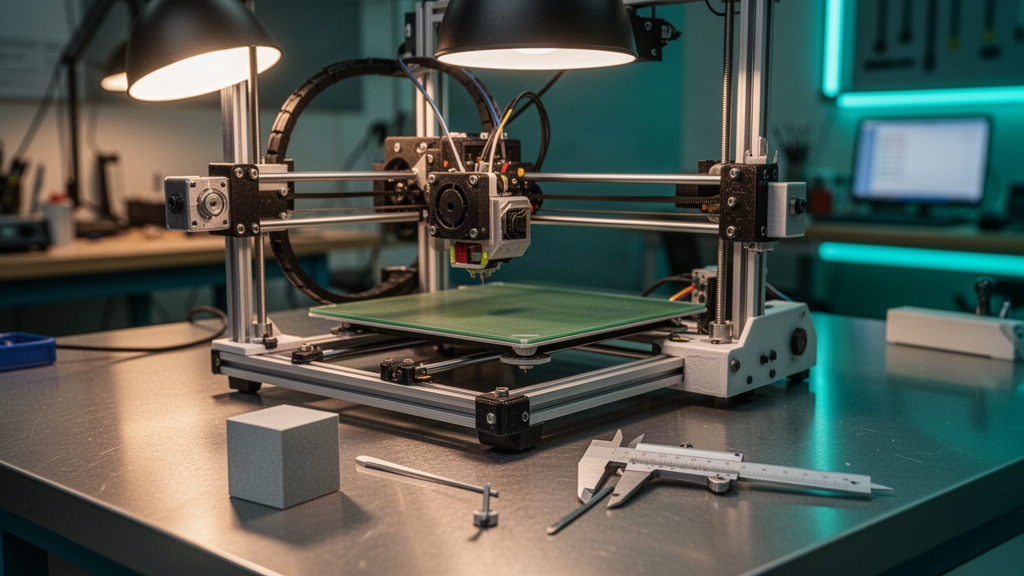
Start with the slicer's material estimate for the actual model, including its selected infill, walls and supports if the slicer includes them. Divide the spool's price by the usable mass in grams. Then multiply by the grams consumed. For example, a £20 spool containing 1,000 g costs £0.02 per gram. If a model consumes 65 g according to the slicer, its nominal filament cost is £1.30. That is a mathematical example, not a claim that filament currently sells for £20 per kilogram.
Now consider additional purge or prime material, discarded failed tests and the difference between the slicer's reported object weight and the entire job's actual consumption. Do not automatically add an arbitrary percentage if the slicer already counted some waste. Either measure the extra material separately or label the allowance clearly. Different colour changes and support structures can dramatically change the waste.
How much electricity does an FDM printer use?
Power draw changes during warm-up, bed heating, motion and the steady part of a job. The maximum rating printed on the power supply is not the same as the average electricity drawn over a complete print. A suitable plug-in energy meter can measure total kilowatt-hours under representative conditions. For estimating only, multiply average kilowatts by duration in hours and then by your price per kWh.
Worked example: if a printer really averages 120 W for four hours, it consumes roughly 0.48 kWh. At an assumed electricity rate of 25 pence per kWh, that is 12 pence of electricity. This is not a guarantee for a particular printer or the live UK price cap. Heated chambers, large beds, cold starting temperatures and other hardware can change the outcome, and the commercial electricity contract may differ from a domestic tariff.
Three practical example calculations for home printing
To make the maths visible, assume PLA at £20 per 1,000 g, average printer power of 120 W and an electricity rate of £0.25 per kWh. These are hypothetical inputs. A small 25 g cable organiser taking two hours uses £0.50 of filament and £0.06 of electricity, or £0.56 direct consumables. A 70 g personalised nameplate taking five hours uses £1.40 of filament and £0.15 of electricity, or £1.55. A 180 g larger desk tray taking ten hours uses £3.60 of filament and £0.30 of electricity, or £3.90.
| Illustrative job | Filament | Electricity | Subtotal before all other costs |
|---|---|---|---|
| 25 g / 2 h cable organiser | £0.50 | £0.06 | £0.56 |
| 70 g / 5 h nameplate | £1.40 | £0.15 | £1.55 |
| 180 g / 10 h desk tray | £3.60 | £0.30 | £3.90 |
Those subtotals leave out labour, machine depreciation, failed prints, postage, finishing, business overheads, marketplace fees and tax. They also presume the slicer weight is the actual material used. They are useful for comparing designs, not for advertising a fixed retail price. Even a short customer conversation and packaging a one-off print may cost substantially more than the plastic itself.
Why machine hours, printer wear and labour matter
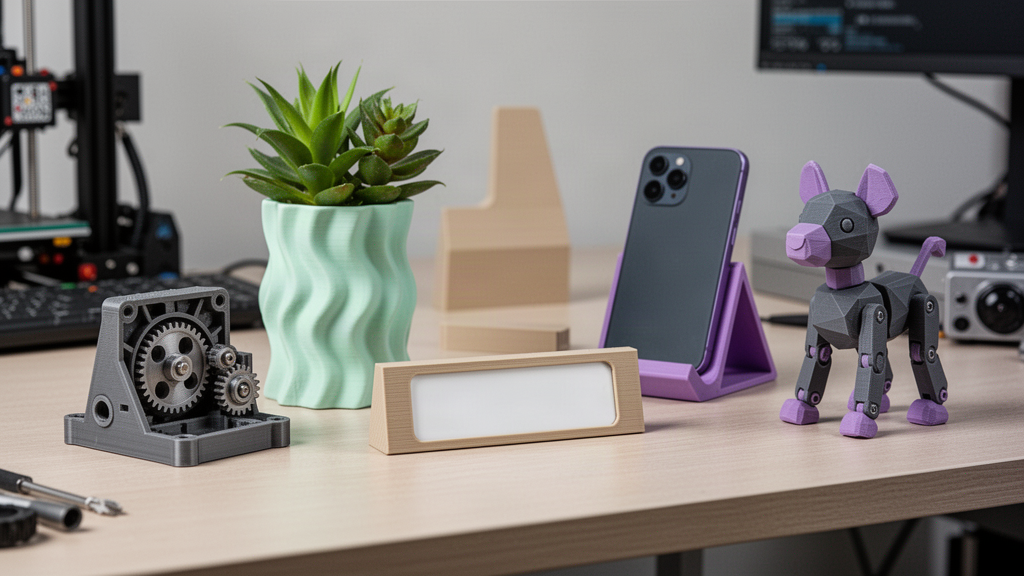
A business cannot operate sustainably using only the cost of plastic. Machines require nozzles, build surfaces, belts, maintenance, electricity, calibration and occasional repair. Time spent slicing a file, reviewing supports and cleaning a finished item is real work. A designer may also need to create or correct a CAD model, which is often a separate service from pressing Print.
For transparent pricing, show a machine-use allowance based on the realistic ownership and maintenance costs of the setup, and separate hands-on labour from unattended machine hours. A seven-hour print does not imply seven hours of hands-on work, but it does occupy equipment. Include only reasonable allowances and make the customer aware of any design fee or minimum-order charge before starting.
Failure risk is another legitimate cost, but it should be derived from real history, not invented to enlarge a quote. If a certain process repeatedly fails, first improve the process rather than charging every customer for avoidable waste. A quality-controlled print service should be able to explain its materials, expected finish and what happens if the item is defective.
Which print settings can make a quote rise quickly?
- Very fine layers increase the number of vertical passes and often total machine time.
- Supports can add filament, finishing labour and visible contact marks.
- Multiple colours may require additional material purging and careful preparation.
- A large, thin-walled object may be deceptively long to print despite relatively modest weight.
- A demanding material can need drying, special build surfaces or more controlled surroundings.
- Tight dimensional tolerance or moving assemblies require extra tests and revisions.
- Urgent deadlines may be impossible if current machines are booked or a prior print must be reworked.
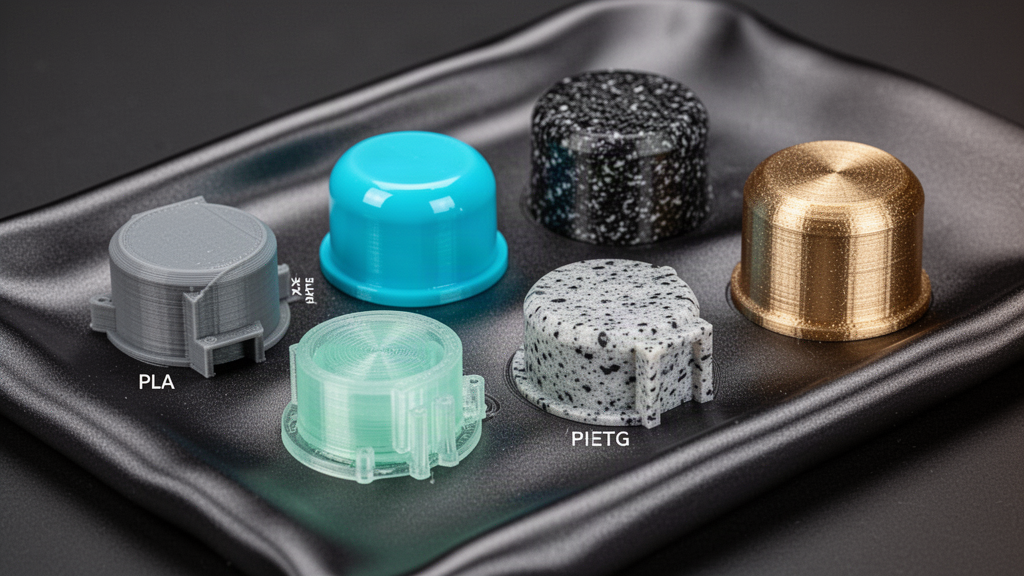
A practical quote describes the object in enough detail that both parties know what will be delivered. If someone asks for a bespoke replacement part, document the critical dimensions and the material expectations. If someone orders a gift, capture the spelling and finish in writing. The most expensive failure can be producing the wrong object perfectly.
Seven questions to ask before accepting a 3D printing quote
- What dimensions and print orientation will be used?
- Is the material suitable for the intended environment and loads?
- Are supports, surface finish and seam location included?
- Does the quote cover CAD design, inspection and post-processing?
- What is the realistic manufacturing and delivery window?
- Are postage, applicable taxes and any minimum-order fee included?
- What happens if the completed item is faulty or differs from the agreed specification?
Under UK consumer law, customised products may have different change-of-mind cancellation rules, but this does not remove consumers' rights when goods are faulty or not as described. Review GOV.UK's official guidance and the seller's written terms. Avoid assuming a livestream request or a virtual print preview represents a confirmed physical order.
How to reduce cost without ruining print quality
Reduce unnecessary material through appropriate wall counts, a sensible infill pattern and a model designed for its purpose. That does not mean using the lowest possible infill for every functional part. Put a high-quality surface only where it matters, choose a realistic layer height for the job and make a small fit test instead of wasting an entire large print.
If you need many similar pieces, design for batch production and minimise unnecessary colour changes. For a single item, compare a professional service with buying an entire machine and learning to operate it: the latter can be rewarding, but it is not automatically cheaper. A clear file, correct dimensions and a realistic delivery expectation help a printer quote accurately.
Frequently asked questions
01How much does one gram of 3D printing filament cost?
Divide the actual spool price by its usable mass in grams. For example, a hypothetical £20 per 1,000 g spool is £0.02 per gram before waste and other costs.
02Is electricity the largest cost of 3D printing?
Not always. It can be modest for many desktop prints, while machine occupancy, labour, finishing, maintenance and failed jobs can dominate a commercial quote.
03Does the slicer show the final selling price?
No. Its estimated weight and machine time can help calculate inputs, but a real selling price must include the other appropriate costs and agreed fulfilment terms.
04Can I get a fixed quote just from a screenshot of a 3D model?
A screenshot rarely establishes correct dimensions, supports, material or manufacturability. A reliable quote needs a reviewed model and specification.
Sources and useful references
We link to official documentation and publisher guidance where useful. Advice and platform features can change; verify current details with the original source, your printer maker and relevant service provider.
Get a genuine, reviewed print quotation
Upload the actual model, share dimensions and material requirements, and request an individually confirmed manufacturing quote.
Start a Printworks enquiry